
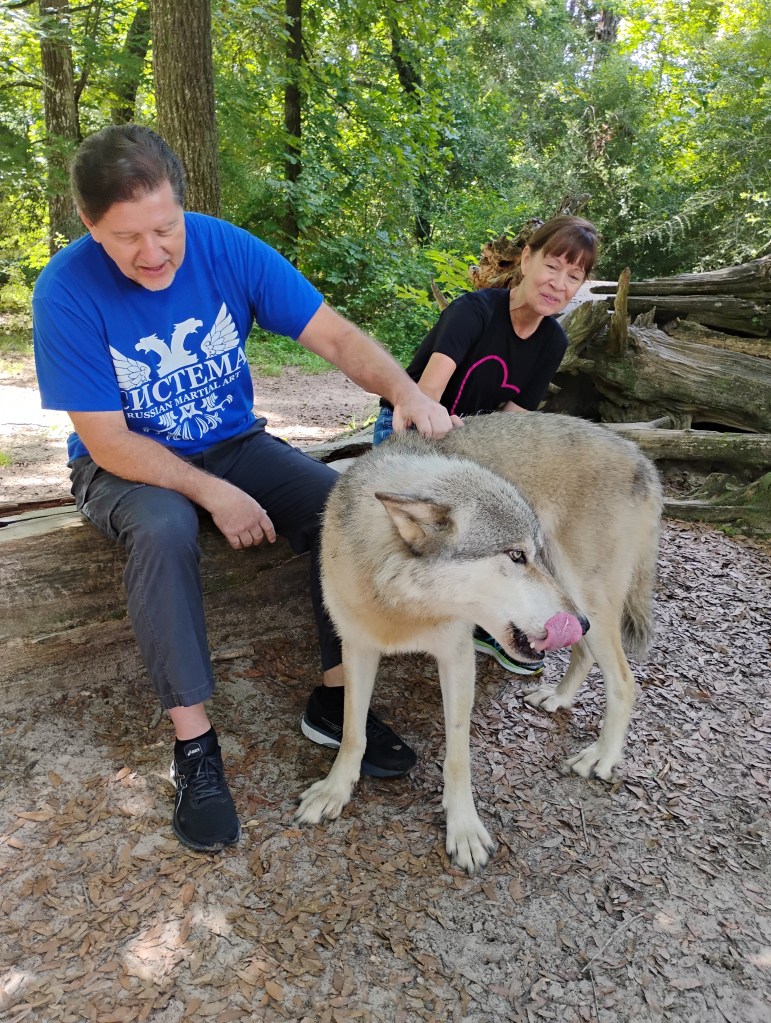
A week ago, my wife and I took another trip to Seacrest Wolf Preserve in Chipley, FL. Though a tiny town, it has rapidly become one of our favorites because of this preserve.
Depending upon the time of year, there will be 25-50 wolves in this 450 acre area. It is quiet, serene and life-altering.
When you drive up to the place and wait for your scheduled tour, not only are you surrounded by nature, you are engulfed by silence. In an ever increasing loud world, the yin quiet begins its healing, even if you are not fully aware of it.
As for the wolves, they are large, stunning and initially intimidating. . . until you go inside the preserve and interact with them. Within seconds, you realize the gentle nature of these magnificent creatures. They reminded me of 150 or so pound labrador retrievers. Powerful yet gentle. Intimidating looking yet with a big, loving heart. Playful and highly misunderstood.
Wolves have long carried the weight of human fear and folklore. Painted as villains in fables and hunted as threats to livestock, their true nature has been shadowed by centuries of misunderstanding. But when we step into the quiet of Seacrest, we experienced something altogether different. Wolves are not monsters—they are models.
At the heart of every wolf pack is a community. One that values care, structure, and contribution. Unlike the myths of children’s novels and movies, wolves are guided by a deep sense of cooperation. The most able hunt and when finished, the elders and the pups eat first. The strong wait. In this world, respect is not demanded but freely given, gently and instinctively.
Even more striking is their generosity. Wolves often leave food behind for other creatures of the forest. They bury some remains from their hunt, allowing ravens, foxes, and even smaller scavengers to benefit from their efforts. This isn’t carelessness. It’s harmony. A wolf takes what is needed, no more. The rest becomes a gift, a quiet offering back to their brothers and sisters in wild community they belong to.
Their bonds are not limited to blood. Wolves raise one another’s young, guard the sick, and mourn the lost. They howl not only to mark territory but to locate family, to sing to the moon, and maybe simply to remember.
We could learn much from them.
In a world that rewards individualism, the wolf reminds us of another way, a path of loyalty, shared strength, and fierce love. A pack doesn’t leave its weak behind. It adjusts its pace. It listens. It moves together as one.

Wolves do not deserve our fear. They deserve our reverence. The Native Americans understood that.
One sacred Native American story tells of the time when the Earth was young. The Great Spirit created man and wolf at the same time, from the same breath. They emerged from the forest side by side, walking as equals. They hunted together, lived together, learned from one another. The wolf taught man about loyalty, family, and survival. In return, man honored the wolf with songs, dances, and deep respect.
But as time went on, the paths of man and wolf began to diverge. Man forgot.
Wolf remembered.
Yet the legend says the bond remains unbroken. Wolf and human are forever linked. What happens to one, touches the spirit of the other. This is why many Native tribes still consider the wolf a sacred teacher, a spiritual brother, a guide through the unseen. When you go to Seacrest, that eternal bond becomes permanently inscribed on your heart.
So when you hear a howl echoing in the distance, it’s not just a call of the wild.
It’s a reminder.
That we once walked side by side.
And if we listen —truly listen— we still can find those better version of ourselves.
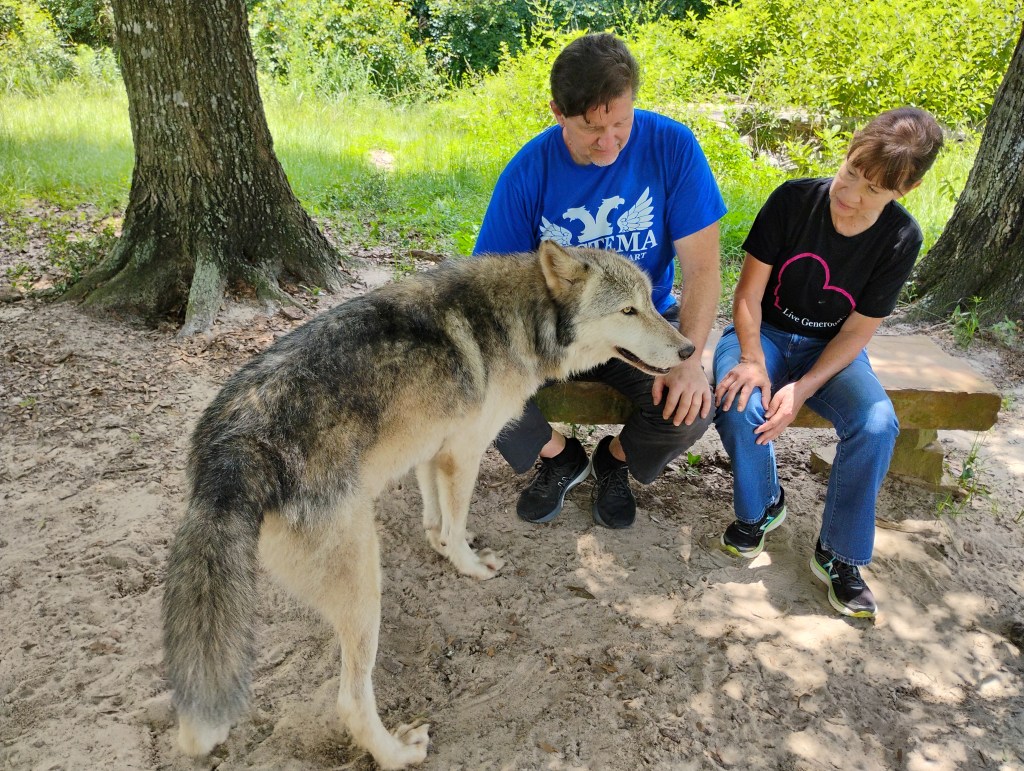
NOTE: We are tremendously thankful for all of the wonderful people at Seacrest Wolf Preserve. You are giving one of the most powerful and beautiful gifts to the world. You certainly have done that for both of us.
 davidorman.com