AMA Wednesday for March 4, 2026

Q: How does chronic shallow breathing alter fascia tension patterns throughout the body, and can retraining breath mechanics measurably improve joint mobility and pain levels?

A: Chronic shallow breathing quietly reshapes the body from the inside out. When breath stays high in the chest and rarely descends into the diaphragm, accessory muscles of the neck and upper ribs become overworked while the deep core system underperforms. Over time this creates tension lines that travel through the fascial web, especially along the superficial front line and lateral lines. The rib cage stiffens, the thoracic spine loses rotation, and the pelvis can begin to tilt or lock in compensation. What begins as a breathing habit becomes a structural pattern.

Fascia responds directly to mechanical load and neurological input. When diaphragmatic movement is limited, the internal pressure system of the torso changes. The diaphragm, pelvic floor, transverse abdominis, and multifidi are designed to function as a coordinated pressure cylinder. Shallow breathing disrupts this synergy, reducing optimal intra-abdominal pressure and forcing the body to stabilize through gripping patterns instead of fluid tension. This gripping often shows up as tight hip flexors, jaw tension, restricted shoulder mobility, and even chronic low back discomfort. The body is not weak. It is overbraced and underbreathe.

Retraining breath mechanics can measurably improve joint mobility and pain levels because it restores rhythm to the entire myofascial system. Slow nasal diaphragmatic breathing with full rib expansion increases parasympathetic tone, reduces unnecessary muscle guarding, and improves oxygen delivery. As the diaphragm regains excursion, the thoracic spine becomes more mobile, the pelvis rebalances, and fascial hydration improves. In practical terms, when breathing deepens, movement often becomes smoother and pain decreases without directly stretching the painful area. The breath becomes both the diagnostic tool and the medicine, a principle that aligns beautifully with your integration of healing and martial structure.

Fascia: The Smart Tissue That Holds More Than We Realize

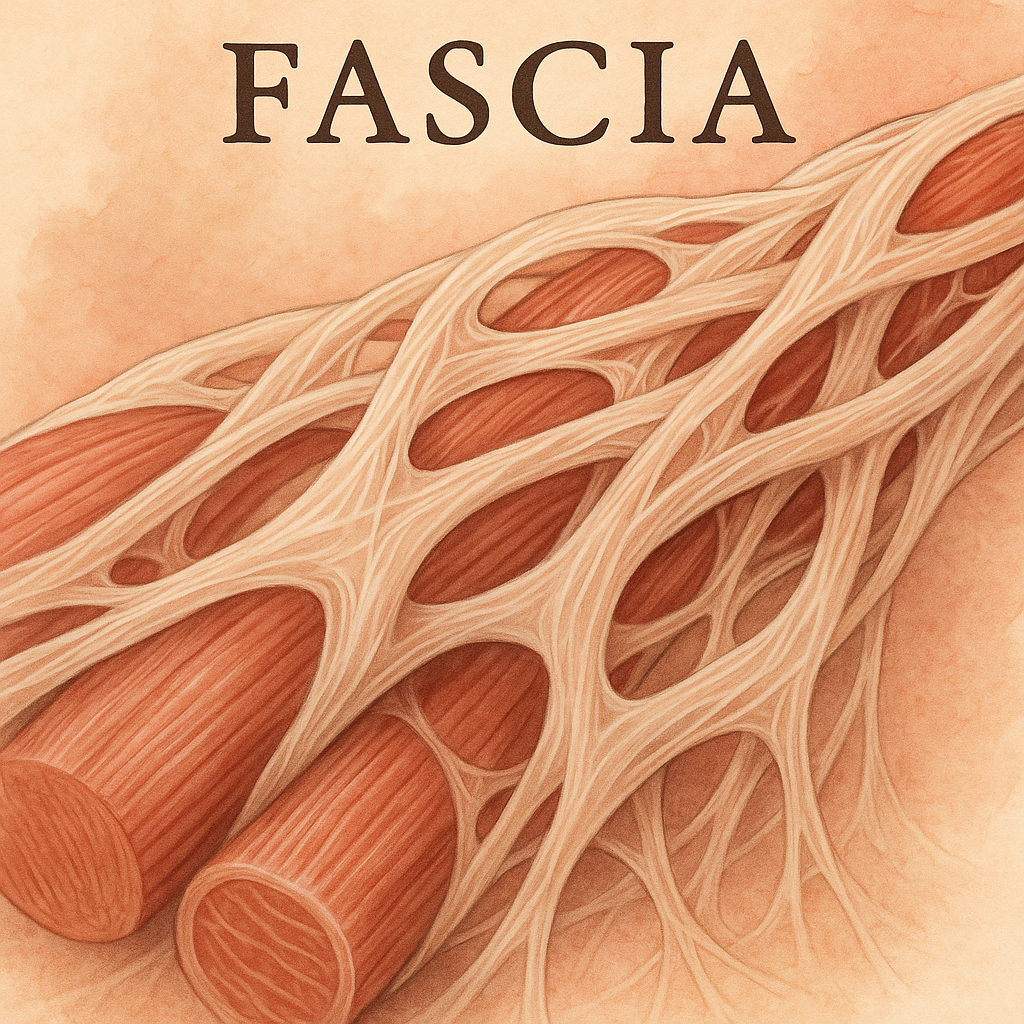
Most people think fascia is just a thin sheet that wraps around the muscles, like plastic wrap around leftovers. They believe its only job is to hold everything in place. But after 15 years of working with fascia, we see it in a much more exciting way that changes how we understand the body itself.

Fascia Is Smart

Fascia is not passive packing material. It is alive, responsive, and intelligent in its own way. Experience shows that fascia can
• Hold memories, storing physical and emotional imprints from past injuries or traumas
• Send signals like electricity, creating a body wide communication network faster than nerves alone
• Collect information from the environment and transmit subtle sensory data to the brain, shaping how we move and feel

Instead of being background tissue, fascia is an active participant in health, movement, and awareness.

The Healthy State of Fascia

When fascia is healthy, it feels and functions like soft jelly. Imagine fiber optic cables carrying beams of light at incredible speeds. Healthy fascia works the same way, transmitting information quickly, fluidly, and efficiently throughout the body. This smooth transmission is what makes movement graceful, recovery faster, and the body more resilient.

What Happens When Fascia Is Unhealthy

Problems arise when fascia stiffens, hardens, or loses hydration. Instead of soft jelly, it becomes tough and rigid, like dried glue. This can lead to stiffness, chronic pain, reduced circulation, and slower healing. Since fascia is made mostly of water, it thrives on hydration, movement, and pressure changes. The tissue itself lives inside tiny pressurized tubes, creating an internal hydraulic system that supports flexibility and flow.

Fascia’s Hidden Role

Fascia holds everything together: muscles, bones, tendons, ligaments, and organs. But it also connects them in ways we are only beginning to understand. It is not just structure, it is communication, memory, and intelligence.

The next time you stretch, move, or breathe deeply, remember that you are not just working muscles. You are awakening fascia, your body’s hidden network of light, water, and information.

5 Powerful Exercises to (Re)Connect Your Core to Your Back and Eliminate Most Back Pain

Plus ONE Bonus Exercise.

Back pain affects nearly 80% of adults at some point in their lives — a staggering statistic that reflects the disconnection between how we move and how we’re designed to move. Often, the missing link lies in the deep core muscles, which are meant to support and communicate with the spine like an inner scaffold. When that connection is lost, discomfort, instability, and injury follow. These 5 exercises are simple yet powerful tools to restore harmony between your core and your back. Rooted in both modern biomechanics and ancient Taoist awareness, this daily ritual is more than physical—it’s a return to center, breath, and embodied presence.

1. Dead Bug (Core-Brain Reset)

Purpose: Activates deep core (transverse abdominis) while stabilizing the spine.

How-to:

  • Lie on your back, arms extended to the sky, knees bent at 90°.
  • Inhale. On the exhale, slowly lower one arm and the opposite leg toward the floor.
  • Keep your lower back gently pressing into the floor.
  • Return and switch sides. Do 6–8 slow, controlled reps per side.

Feel: Like your brain and core are syncing up. Smooth and precise movement is the goal.


2. Cat-Cow with Diaphragmatic Breathing

Purpose: Mobilizes the spine while syncing breath with movement, calming the nervous system.

How-to:

  • Start in tabletop position.
  • Inhale deeply into your belly and arch your spine (Cow).
  • Exhale fully, rounding your spine and drawing the navel in (Cat).
  • Focus on slow, rhythmic breath.

Feel: The breath massaging your spine from the inside out.


3. Bird-Dog (Cross-Body Control)

Purpose: Trains core stability and strengthens deep spinal stabilizers (multifidus, erector spinae).

How-to:

  • From tabletop, extend one arm and the opposite leg.
  • Keep hips square and stable—avoid shifting or leaning.
  • Hold for 3–5 seconds, then switch. Do 5–8 reps per side.

Feel: The cross-pattern neural wiring activating — reconnecting brain, spine, and core.


4. Wall Press March (Anti-Extension Core Drill)

Purpose: Re-engages the deep core while minimizing back strain. Very safe if you’ve had herniated discs.

How-to:

  • Stand or lie on your back with knees bent and feet on the floor.
  • Press hands into a wall (or resistance band) while lifting one knee to 90°.
  • Alternate knees while keeping constant pressure with your hands.
  • Stay connected to your breath.

Feel: Deep, internal core “firing” without overusing your hip flexors or lower back.


5. Supine Pelvic Tilts or Rolling Bridge

Purpose: Gentle way to realign pelvis, activate glutes, and release tension from lumbar spine.

How-to:

  • Lie on your back with knees bent, feet flat.
  • Inhale, gently arch lower back. Exhale, flatten it and press into the floor.
  • For bridges: Press through your heels and lift hips slowly, peeling spine off floor one vertebra at a time.
  • Lower with control. Do 8–10 slow reps.

Feel: Like you’re massaging the spine from the inside while syncing your breath with movement.


Bonus Taoist Tip:

Before or after, stand in Wu Ji posture (standing meditation): feet shoulder-width apart, soft knees, tailbone gently tucked, and crown lifted. Breathe into the lower dantian. Feel the subtle connection between spine and breath.

As you breathe up, think POWER. As you exhale and breathe down, think GRACE.

This is a Yin/Yang balance. Power is the ability to go through issues while Grace is the ability to deal with issues minus conflict.

Keeping Your Knees Healthy: A Natural Medicine Perspective

In Oriental and Natural medicine, the knees are often referred to as the “pillars of the body,” playing a vital role in mobility, balance, and overall vitality. According to traditional Chinese medicine and other natural healing systems, knee health is deeply connected to the flow of Qi, blood circulation, and the balance of the body’s internal systems. By adopting holistic practices rooted in Oriental and natural medicine, you can maintain strong, flexible, and pain-free knees throughout your life.

The Role of Qi and Blood in Knee Health

In Natural Medicine, the knees are governed by the Kidney and Liver meridians. The Kidneys are believed to control the bones, while the Liver governs the tendons and ligaments. When Qi and blood flow smoothly through these meridians, the knees remain nourished and resilient. However, stagnation, deficiency, or imbalance in these systems can lead to stiffness, pain, or weakness in the knees.

Cold and dampness are also considered major culprits in knee problems. Exposure to cold or damp environments can obstruct the flow of Qi and blood, leading to conditions like arthritis or chronic pain. To counteract this, it’s essential to keep the knees warm and dry, especially during colder months.

Natural Practices for Knee Health

  1. Acupressure and Acupuncture: Stimulating specific acupoints can help restore the flow of Qi and blood to the knees. Key points include ST35 and GB34, which supports the tendons and ligaments. Regular acupressure or acupuncture sessions can alleviate pain and improve mobility.
  1. Herbal Remedies: Natural Medicine often relies on herbal formulas to strengthen the Kidneys and Liver, which in turn support knee health. Herbs like Eucommia Bark (Du Zhong), Dang Gui (Angelica sinensis), and Turmeric (Jiang Huang) are commonly used to reduce inflammation, nourish the joints, and improve circulation. Herbal poultices or liniments can also be applied topically to soothe sore knees.
  1. Dietary Therapy: Food is medicine. To support knee health, focus on warming, nourishing foods that strengthen the Kidneys and Liver. Bone broth, black sesame seeds, walnuts, and dark leafy greens are excellent choices. Avoid excessive consumption of cold or raw foods, as they can weaken the digestive system and contribute to dampness.
  1. Tai Chi and Qigong: These gentle, flowing exercises are cornerstones of TCM for maintaining joint health. Tai Chi and Qigong promote the smooth flow of Qi, improve balance, and strengthen the muscles around the knees without putting undue stress on the joints. Regular practice can prevent stiffness and enhance overall vitality.
  1. Moxibustion and Cupping: Moxibustion, the burning of mugwort near the skin, is used to warm the knees and dispel cold and dampness. Cupping therapy can also improve blood circulation and relieve tension in the muscles surrounding the knees.

Preventative Measures

Prevention is a key principle in Oriental medicine. Avoid overexertion, especially activities that strain the knees, such as prolonged kneeling or heavy lifting. Maintain a healthy weight to reduce unnecessary pressure on the joints. Additionally, wearing supportive footwear and using knee pads during physical activities can protect the knees from injury.

Conclusion

From the perspective of Oriental and natural medicine, knee health is a reflection of the body’s overall balance and vitality. By nurturing the flow of Qi and blood, strengthening the Kidneys and Liver, and adopting mindful practices, you can keep your knees strong and resilient. Embrace these time-tested traditions to ensure your “pillars of the body” remain steady and pain-free for years to come.