The Quiet Collapse of Human Intelligence in the Age of AI

Artificial intelligence is quietly dismantling the foundations of human creativity. What once required imagination, effort and soul is now replaced with instant answers and machine-generated ideas. When people stop wrestling with their own thoughts, they stop discovering who they are. Creativity withers when there is no struggle. Originality dies when everything is copied, predicted or synthesized for you. The human spirit grows through the act of creation, and AI steals that growth by offering shortcuts that cost far more than they save.

As reliance grows, motivation collapses. Why push yourself when the machine can do it faster. Why learn, refine or master anything when the illusion of mastery can be produced in seconds. This dependency becomes a trap that feels convenient but slowly erodes the ability to think independently. The mind becomes passive. Curiosity fades. The reward centers of the brain weaken because achievement no longer requires effort. AI becomes not a tool, but a crutch, and eventually a cage.

AI becomes not a tool, but a crutch, and eventually a cage.

A glaring example of this trend unfolding in real time is the rise of Suno, a generative AI music company whose CEO is Mikey Shulman. Suno claims to democratize music creation by letting users generate full songs from simple text prompts. As Shulman recently put it: “There is a really big future for music where way more people are doing it in a really active way, and where it has a much more valuable place in society.” That statement reflects Suno’s misguided ambition. What Suno offers is not genuine music creation but imitation. By producing songs through algorithmic recombination of existing patterns, Suno risks stealing from real creators, diluting originality, and flooding the landscape with hollow, soulless content.

The deeper danger is the long-term cognitive and cultural decline that follows widespread reliance on tools like Suno. When the brain stops practicing critical thinking, memory formation and original problem solving, those abilities atrophy. Intelligence lowers through disuse. You cannot become sharper by outsourcing your mind. You cannot produce meaningful art by letting a machine do everything for you. The real threat is not that AI might surpass human intelligence. The real threat is that humans are letting their own intelligence and creative spirit decay by surrendering the practices that made them intelligent and alive in the first place.
Keyboard Diseases: How Hidden Hands Are Rewiring Our Minds

We live in an age where many of us are healthier in body than ever before but what about the health of how we think, act, and engage with others? There is a subtle epidemic, one with no physical symptoms yet capable of warping character, relationships, and the very way we see truth. I call them “keyboard diseases.” They compulsive online behaviors that destroy empathy, distort courage, and replace authentic action with keyboard echo. In the grip of this, we drift from being human to being a keyboard, typing out versions of ourselves we barely recognize.

Here are examples of this:

At first glance, cell-phone addiction seems benign, a modern (in)convenience. But it is not neutral. Every ping, every notification, pulls attention away from the sweet Now. Like an itch we cannot help scratching, our thumbs swipe, our focus splinters, and presence recedes. Then comes the hidden rant: the furious keyboard warrior who would never speak such things in person yet fires off messages when behind the safety of screens, comforted by distance and anonymity. Add to that the darker seeds: plotting harm, orchestrating divisive narratives, and using digital tools to hide intentions. These are not fringe phenomena—they are daily nuisances, internal viruses eating at virtue and clarity.

Beyond them lies another terrain, that of digital vigilantism and “echo chambers.” We now have armies of moral judges ready to pounce via screenshots, threads, and mass shaming. What starts as righteous indignation quickly becomes ritual bloodletting. Parallel to that, we collapse into echo chambers where the subtle is erased and complexity punished. We only share what confirms what we believe, we only hear what soothes our self-image. It someone disagrees, the mass of nasty verbiage comes raining down from the hidden keyboard.

And then there is doomscroll dependency, the addictive consumption of negative, fear-laden content. We ride each headline like a wave of anxiety, honing a worldview in which everything is crisis, betrayal, and collapse.

To understand why so many fall prey, we can learn a great deal from behavior science, especially the work of one of my favorites, Chase Hughes. Hughes, a former military intelligence officer turned behavior specialist, teaches that much of what we believe is our free choice is shaped (often invisibly) by how we process others, how we read signals, how we allow fear and insecurity to lead us. He teaches tools like the Behavioral Table of Elements (a framework for observing nonverbal cues, clusters of stress, and patterns of deception). He emphasizes that communication is not just in the words, but in posture, eye movement, voice tonality, all tools that both others and we ourselves use to influence perception.

This helps explain why “keyboard diseases” take root so easily. Behind the keyboard, people hide much (all?) of the nonverbal self. They strip away the cues that force accountability: the eyes that look away, the voice that quivers. They amplify what they think but rarely test, choosing content that confirms rather than challenges.

People then are easier targets for manipulation, both by others and by ourselves, because we believe our own posture is safe, our own rationality intact. Hughes warns of the “firewall illusion,” the false belief that one is immune to manipulation; ironically, believing that makes us more vulnerable.

Yet there is hope. Recognizing these “keyboard diseases” is the first step back to integrity. We can begin to reclaim our humanity by slowing down, by insisting on face-to-face communication from time to time, by stepping into conversation rather than comment threads. We can practice observing behavior, ours first, then others, like Hughes suggests. Notice how we sit, how we look, what our default gaze is, journaling small signals of discomfort or fear. We can challenge ourselves to consume what uplifts, not only what enrages. We can question what we share, and to pause before we type.

In the end, we are more than keyboards, more than screens or threads. We are bodies, minds, hearts — responsive, relational, vulnerable. These “keyboard diseases” steal from us not just civility, but presence, compassion, and the subtle courage of living fully. To heal, we need to put the keyboard in its proper place and recognize it as a tool, not a refuge. A mirror, not a mask. A servant, not a sovereign. Returning to that posture may seem small. But it is the ground on which true transformation grows.

It is the key to returning to a heart driven, compassionate society.

Ask Me Anything Wednesday for July 9 2025

Question: “If your body could write you a letter right now using the language of natural medicine — what do you think it would say? Herbs, energy systems, foods, feelings… nothing is off limits. Let’s talk healing.”

Answer: If my body could write me a letter through the lens of natural medicine, it might begin gently, like a whisper from the forest. “Dear one,” it would say, “I carry the story of your choices in my muscles, your thoughts in my breath, your history in my blood. You’ve often treated me like a machine, but I am not made of steel — I am made of rhythm, water, fire, and the unseen.” It would ask me to listen not with my ears, but with my pulse.

The letter would go on to say, “I crave balance, not perfection. I am soothed by adaptogens, not stimulants. I need rest as much as movement, silence as much as sound. Your liver longs for dandelion and milk thistle, not caffeine and worry. Your lungs miss the scent of pine and fresh air. Your joints ache not just from time, but from what you’ve suppressed. Let’s clear the inflammation with turmeric, laughter, and honest tears.”

It would remind me that healing is not a straight line. That the grief in my chest is just as important to treat as any lab result. That acupuncture opens hidden meridians the same way forgiveness opens the heart. “Your skin speaks your gut’s language,” it might write, “and your headaches are not random — they’re petitions for change.” It would ask me to eat with presence, to breathe with reverence, and to love this vessel like a sacred home.

And finally, it would say, “I am not against you. I am your oldest ally. But I am tired of shouting. Let us return to a gentler medicine — one of roots, rituals, movement, and moonlight. When you care for me naturally, I won’t just heal… I’ll awaken.”

The Truth About Wolves: Nature’s Misunderstood Leaders

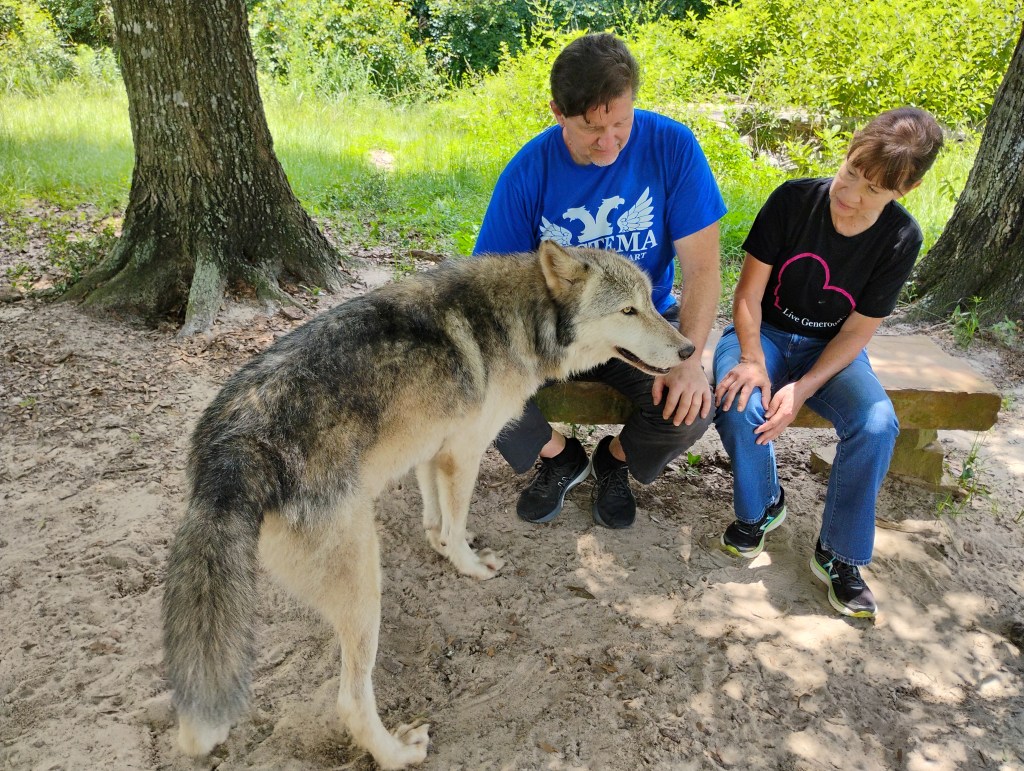
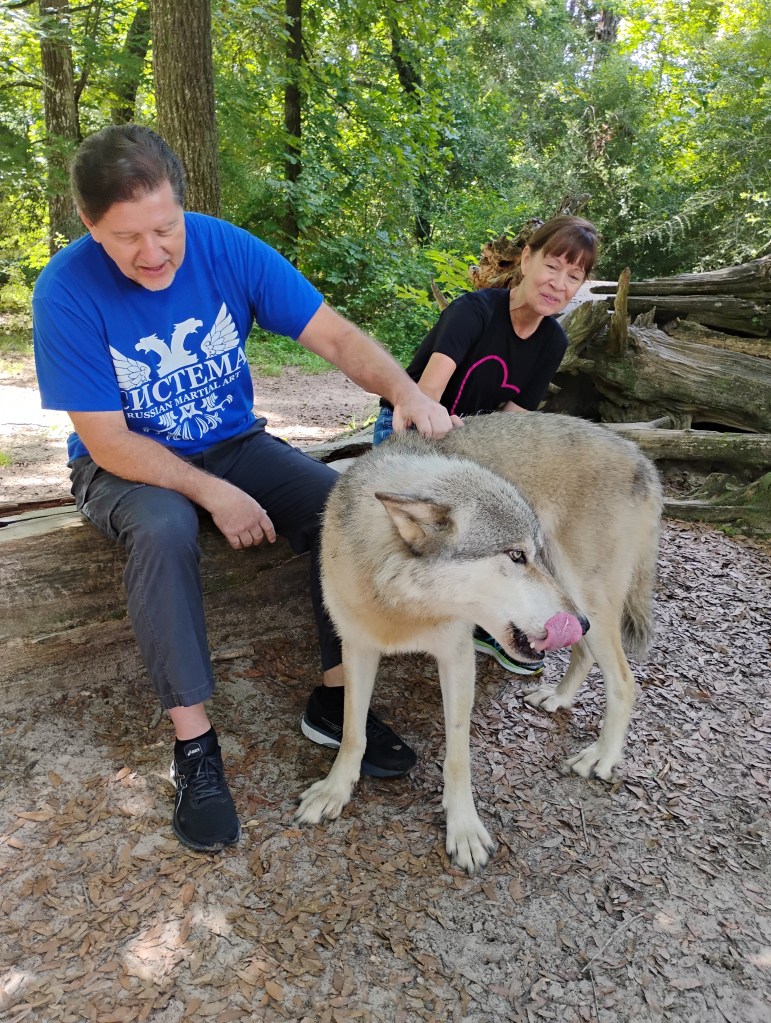
A week ago, my wife and I took another trip to Seacrest Wolf Preserve in Chipley, FL. Though a tiny town, it has rapidly become one of our favorites because of this preserve.

Depending upon the time of year, there will be 25-50 wolves in this 450 acre area. It is quiet, serene and life-altering.

When you drive up to the place and wait for your scheduled tour, not only are you surrounded by nature, you are engulfed by silence. In an ever increasing loud world, the yin quiet begins its healing, even if you are not fully aware of it.

As for the wolves, they are large, stunning and initially intimidating. . . until you go inside the preserve and interact with them. Within seconds, you realize the gentle nature of these magnificent creatures. They reminded me of 150 or so pound labrador retrievers. Powerful yet gentle. Intimidating looking yet with a big, loving heart. Playful and highly misunderstood.

Wolves have long carried the weight of human fear and folklore. Painted as villains in fables and hunted as threats to livestock, their true nature has been shadowed by centuries of misunderstanding. But when we step into the quiet of Seacrest, we experienced something altogether different. Wolves are not monsters—they are models.

At the heart of every wolf pack is a community. One that values care, structure, and contribution. Unlike the myths of children’s novels and movies, wolves are guided by a deep sense of cooperation. The most able hunt and when finished, the elders and the pups eat first. The strong wait. In this world, respect is not demanded but freely given, gently and instinctively.

Even more striking is their generosity. Wolves often leave food behind for other creatures of the forest. They bury some remains from their hunt, allowing ravens, foxes, and even smaller scavengers to benefit from their efforts. This isn’t carelessness. It’s harmony. A wolf takes what is needed, no more. The rest becomes a gift, a quiet offering back to their brothers and sisters in wild community they belong to.

Their bonds are not limited to blood. Wolves raise one another’s young, guard the sick, and mourn the lost. They howl not only to mark territory but to locate family, to sing to the moon, and maybe simply to remember.

We could learn much from them.

In a world that rewards individualism, the wolf reminds us of another way, a path of loyalty, shared strength, and fierce love. A pack doesn’t leave its weak behind. It adjusts its pace. It listens. It moves together as one.

Wolves do not deserve our fear. They deserve our reverence. The Native Americans understood that.

One sacred Native American story tells of the time when the Earth was young. The Great Spirit created man and wolf at the same time, from the same breath. They emerged from the forest side by side, walking as equals. They hunted together, lived together, learned from one another. The wolf taught man about loyalty, family, and survival. In return, man honored the wolf with songs, dances, and deep respect.

But as time went on, the paths of man and wolf began to diverge. Man forgot.

Wolf remembered.

Yet the legend says the bond remains unbroken. Wolf and human are forever linked. What happens to one, touches the spirit of the other. This is why many Native tribes still consider the wolf a sacred teacher, a spiritual brother, a guide through the unseen. When you go to Seacrest, that eternal bond becomes permanently inscribed on your heart.

So when you hear a howl echoing in the distance, it’s not just a call of the wild.

It’s a reminder.

That we once walked side by side.

And if we listen —truly listen— we still can find those better version of ourselves.

NOTE: We are tremendously thankful for all of the wonderful people at Seacrest Wolf Preserve. You are giving one of the most powerful and beautiful gifts to the world. You certainly have done that for both of us.